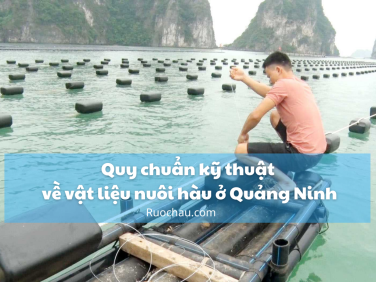
Oyster farming with tires can be said to bring many benefits to farmers. By taking advantage of rubber tires, the cost of oyster farming is significantly reduced. However, this farming method increasingly deteriorates the beautiful images of the sea. At the same time, it increases the risk of poisoning water sources. Many hypotheses have even been put forward that eating oysters raised with tires can cause cancer. What is the truth of these issues? Let’s follow the article below by Bavabi.
Traditional Pacific oyster farming
Since ancient times, fishermen have raised Pacific oysters using traditional methods. Including using bamboo, wood, fishing line, concrete… as a substrate for oysters to grow on. Oysters will grow here until they are harvested.
However, the traditional oyster farming method takes a lot of time and effort. Fishermen have to spend more time setting up than usual. Not to mention that bamboo and wooden poles are easily damaged after being soaked in water.

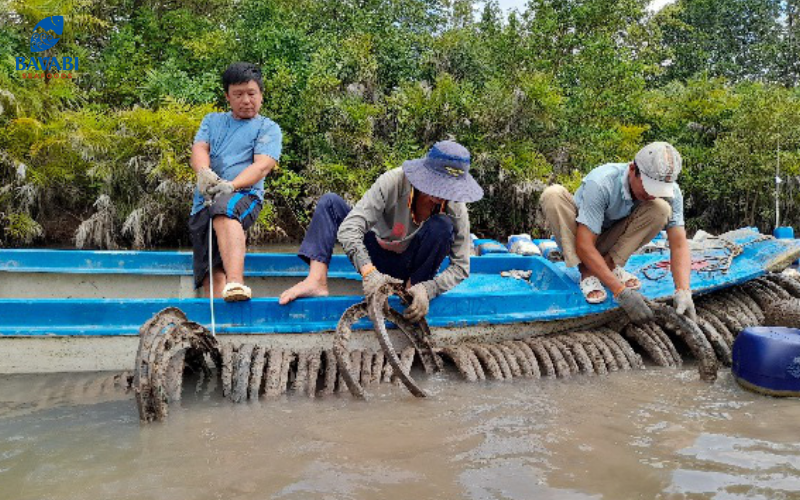
Therefore, many fishermen have come up with the “initiative” of raising oysters using rubber tires from bicycles and motorbikes. From there, instead of using wooden poles, bamboo poles… fishermen have dropped tires directly into the water to create a substrate for oysters to cling to and grow.
This farming method takes less time to plant the substrate, is durable in brackish water environments, and is easy to harvest. Therefore, oyster farmers have “multiplied” it quickly.
The downside of raising Pacific oysters with tires
Every year, when the oyster farming season comes, tens of thousands of tires are thrown into the sea. This has greatly damaged the beautiful images of the ocean. Especially the famous oyster farming areas in Lang Co – Hue, Dam Nai – Ninh Thuan…
Not only that, when these rubber tires are submerged under the sea, they also increase the risk of polluting the underwater and terrestrial environment. In many localities, the Ministry of Agriculture & Rural Development (MARD) has had to step in to inspect.
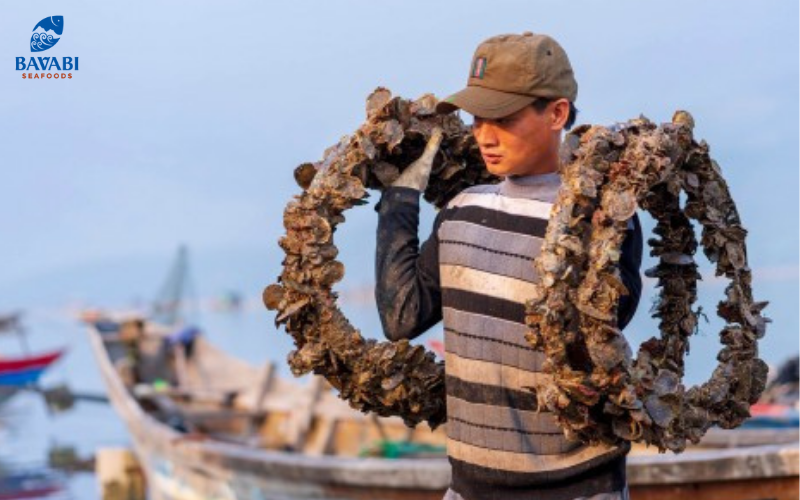
It can be seen immediately that if oysters are raised with tires, the most worrying thing is the waste for the environment. Because tires are very difficult to decompose if they drift in the sea. This will create pollution of the marine space. Tires that are thrown away or drifted ashore will be very difficult to decompose. Creating a dangerous waste for the marine environment and the terrestrial environment.
Does eating oysters raised on tires cause cancer?
Chemically, tires are mainly made of rubber and other additives are added through the process of fluorination and chlorination to make the tires firm, difficult to dissolve, and difficult to decompose. These additives are very difficult to dissolve in water. There is no basis for oysters to eat toxic substances from tires.
Many opinions say that tires contain Sulfur and Carbon which can be harmful to humans. However, many experts have also confirmed that tires contain Sulfur that is vulcanized with Polymer chains in rubber to concentrate and is very difficult to decompose.
On the other hand, the element Sulfur is not harmful to health. Many people still use it as food for animals. As for the good Carbon, it is only in the form of coal that does not affect human health when eating oyster meat.
On the other hand, oysters also only adhere to tires as a living environment. They adhere with a layer of glue produced from the oyster shell like oysters adhere to concrete piles, wooden piles, bamboo piles. The use of tires as a substrate for oyster farming does not directly cause danger to human health at present.
Floating Oyster Farming Method
Currently, to overcome the situation of oyster farming with tires, many localities have successfully applied the method of oyster farming with HDPE floating buoys. This is the method of oyster farming with rope buoys.
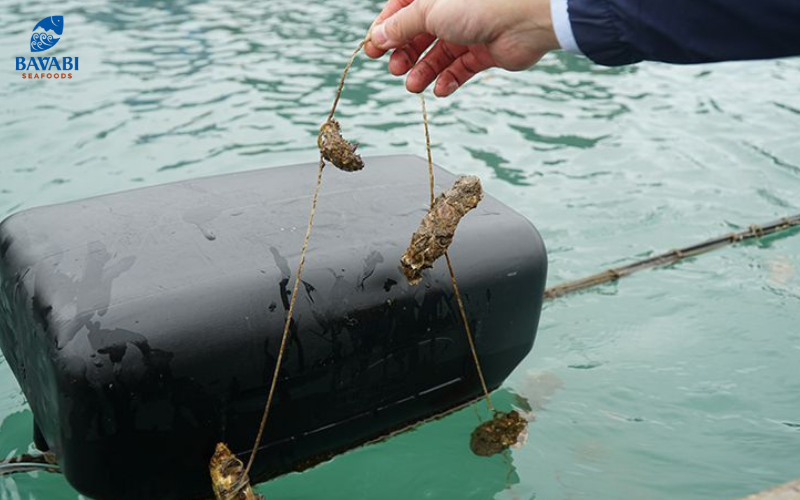
Accordingly, the buoys are attached to each other with a rope. The oyster seed substrates are placed on the ropes hanging 25 – 30cm apart. The buoys can be made of foam or plastic.
This oyster farming method is extremely environmentally friendly. However, the initial investment cost will be a bit higher than traditional methods. Therefore, fishermen really need support from the State as well as local authorities and agencies.