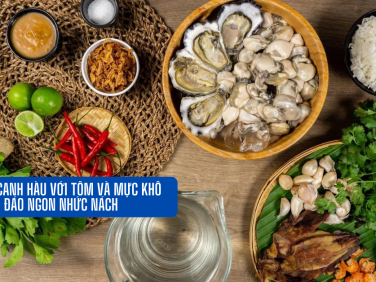
Usually, around Christmas and the end of the year, French people flock to buy oysters at fish stalls in markets or supermarkets. This is a very popular seafood dish on the year-end banquet tables of French people, why is that?

1. History of oyster development in France
Throughout the 20th century, this mollusk suffered from many different epidemics. Starting from the 1920s, almost all flat-shelled oysters were eradicated. Thanks to this, the Portuguese concave oyster thrived but then suffered the same fate of mass extinction in 1970.
By 1971, the Japanese oyster – the Pacific oyster (Crassostrea gigas) appeared, a variety that was said to be more resistant, and is now grown in all French oyster farms, from the Thau lagoon in the Mediterranean to the English Channel. But disease has not spared the Pacific oyster. In 2008, a virus swept through oyster farms. In some places, production was lost by up to 90% – a tragedy for the « sea farmers ». Nevertheless, France remains the largest oyster supplier in Europe: Since 2008, France has exported 80,000 tonnes of oysters per year, 50 tonnes less than before, but still 10 times more than Ireland, the second largest exporter.
Since 1997, the French Institute for Marine Exploitation Research (Ifrmer) has bred a new variety of oyster: a triploid (normal oysters are diploid because they only have two pairs of chromosomes) that the aquaculture community calls the “four-season oyster”. This new oyster has been modified to be highly resistant and can be harvested all year round. It is not a genetically modified organism (OGM) but a living modified organism (OVM). The biggest benefit for farmers is that this new oyster can reach maturity in just 2 years, instead of 3-4 years like naturally farmed oysters. This is a new miracle for oyster farmers.
However, that miracle only lasted for 20 years. Now, oyster farmers are facing another threat. According to Mr. Benoit Le Joubioux, President of the Association of Traditional Oyster Farmers, industrial farming is creating oysters with poor genetic quality due to the high density of farms, the degradation of the marine ecosystem, and the loss of biodiversity… To ensure production, seafood farmers use a lot of antibiotics, causing oysters to gradually lose their resistance and ability to adapt to poor natural conditions, leading to a high risk of mass deaths. That is not to mention the harmful consequences for the environment from industrial farming.
2. Why did oysters become a favorite dish of the French?
In Europe, the Romans loved flat-shell oysters (Ostrea edulis) and had them brought back to the Marennes lagoon, then developed oyster farming as early as the first century BC, by collecting branches with newly hatched oysters attached to them and bringing them back to release them in coastal lagoons to grow.
In the Middle Ages and Renaissance, oysters were viewed as a dish from many opposing perspectives. Coastal people ate them every day and considered them food for the poor. Then gradually, wealthy urban people loved them and considered them a luxury food. Transported by land or river from the coastal regions of Charente-Maritime, Normandy and Brittany and preserved in ice, oysters became a delicacy of kings and nobles.
It is said that King Louis XIV ate several dozen oysters every day, as soon as he woke up. Therefore, pack horses had to be used to transport oysters to meet the King’s demand. Oysters were so popular that by the end of the 18th century, the French government had to issue measures to protect this natural aquatic resource.
In the 19th century, Napoleon III issued management laws, especially prohibiting fishing during the oyster spawning months (from May to August), and at the same time, the maritime authority conducted statistics on the oyster larval collection system. Since the Portuguese concave oyster (Crassostrea angulata) was introduced to the French coast, oyster fishing areas and oyster farming techniques have been increasingly developed.
Currently, there are thousands of French oyster producers to meet market demand. The quality of French oysters caught naturally has a lot of fatty meat in the spring, white and fragrant like milk in the summer and delicate and elegant in the winter, so it is loved by many French people.